Yellowstone Park, Grey Wolves and the Positive Life Cascade
Disruption has a way of arriving uninvited.
It changes the plans we had for our lives, unsettles our sense of safety and can leave us feeling as though the ground beneath us is constantly shifting. In essence, our personal eco system is put under threat. For those who are experiencing or have experienced disruption, we know that this is not an abstract idea but something we experience day after day. Disruption comes in many forms throughout life, doesn’t it?
Disruption can bring loss, uncertainty and moments when hope feels difficult to hold onto.
Yet throughout nature, we see that disruption also reveals something important: systems can change, relationships can heal and even when balance has been lost, it is sometimes possible to find a new one.
One of the most remarkable examples in nature of disruption followed by recovery comes from Yellowstone National Park, where the disappearance of a single species gradually altered an entire ecosystem.
It’s a story that reminds us that even when change is slow, complex and far from straightforward, hope can emerge in places we least expect.
By the 1920s, wolves were totally wiped out from Yellowstone National Park due to deliberate government predator control programs and unregulated hunting.
As a result of this, the elk population in Yellowstone exploded and without the wolves as their predators, they grazed peacefully in open valleys and along riverbanks for decades. This led to devastating overgrazing of vegetation. Young trees were being eaten so not growing to maturity and riverbanks were decimated. The beaver population declined, there was a loss of birds and aquatic life and the food chain became imbalanced. Coyotes became the top predators by default, overhunting small rodents and rabbits. This starved out smaller predators like foxes, hawks and badgers. Furthermore, because elk only died in large numbers during exceptionally harsh winters, scavengers like ravens and eagles lacked a consistent year-round food source.
Something had to be done.
In 1995, a programme to reintroduce wolves was started and over a 2-year period, a total of 31 Canadian Grey Wolves were introduced. The hope was that this would begin a process called ‘Trophic Cascade’.
Ecosystems are organised in ‘trophic’ levels e.g. plants, herbivores, carnivores – when a change disrupts these levels – there is a cascade which goes either up or down.
By returning a single apex predator to the ecosystem, humans triggered an extraordinary chain reaction that ultimately transformed the entire physical geography of the park, showing how deeply interconnected the natural world is.
The remarkable ecological recovery unfolded through these interconnected stages:
The “Ecology of Fear” Changed Elk Behaviour
Now, the elk became vigilant and began avoiding open areas, valleys and gorges where wolves could easily trap them.
Vegetation and Forests Bounced Back
Because elk stopped lingering in the valley bottoms, woody plants like willows, aspens, and cottonwoods grew rapidly providing new nesting habitats for migratory birds and critical nourishment for insects and bears
Beavers Returned as Ecosystem Engineers
The resurgence of willow trees provided the exact food and building material that beavers needed to survive. When wolves arrived, there was only one beaver colony left in the park; today, there are multiple thriving colonies. The beavers built their dams, creating slow-moving pools and wetlands. These new aquatic habitats quickly filled with fish, amphibians, ducks, and otters
The wolves fundamentally altered the local food web. They heavily reduced the overpopulated coyote numbers, which allowed small mammals like rabbits and mice to rebound. This provided a massive food boost for foxes, hawks, and badgers. Furthermore, the leftover carcasses from wolf hunts provided a vital winter food source for scavengers like bald eagles, ravens and grizzly bears.
The most stunning outcome was the physical transformation of the waterways. As the newly grown trees flourished along the riverbanks, their expanding root networks stabilised the soil and dramatically reduced erosion. The wolves, fundamentally changed the rivers.
When the wolves returned, they set off a chain reaction. Healing one element caused a cascade of positive effects across the entire ecosystem.
I love the story of the recovery of Yellowstone because for me, it has a human parallel.
We don’t have to fix every single problem in our lives at once.
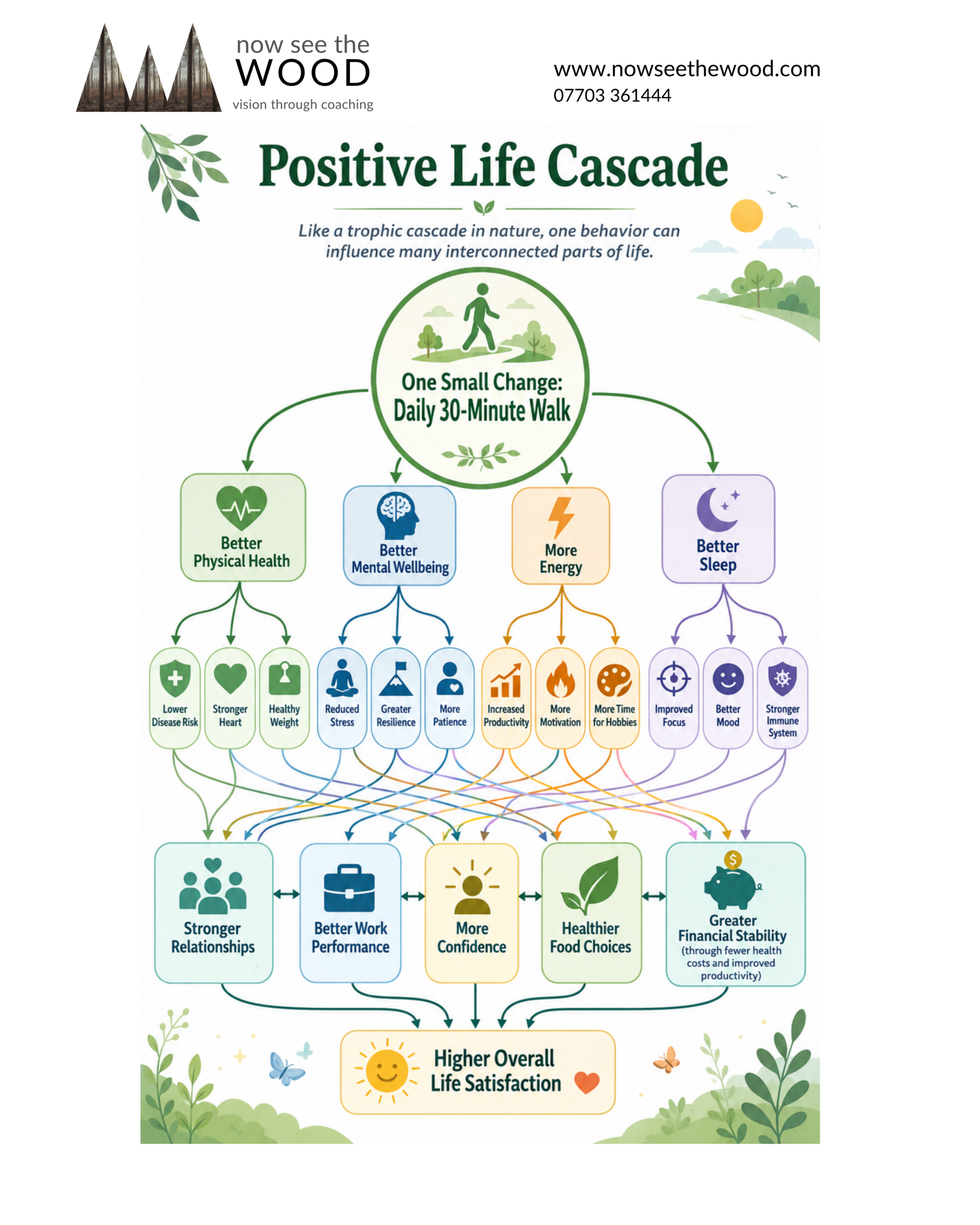
If we focus on one anchor habit, like a daily walk, a consistent sleep schedule or taking time out for an activity that focuses our mind, healing in one single area will naturally cascade, positively, transforming our mood, our relationships and our physical health – without us having to force them all simultaneously.
The elk began to fear grazing in the open valleys so this allowed the young saplings to grow. Once the trees returned, the beavers arrived to build dams, creating still pools that nurtured entirely new forms of life.
For us, it’s incredibly difficult to heal in isolation. When we are rebuilding our life or parts of our life, it’s important for us to allow our own ‘ecosystem engineers’ – like supportive friends, support groups or mentors – to enter into our world.
The wolves changed the very path of the rivers, making them steadier and less prone to erosion.
For us, recovery doesn’t just fix a temporary mood, it completely alters our baseline. Over time, consistent healing, changes the ‘geography’ of our minds. We find that we’re less erratic, we form deeper emotional boundaries and we become more resilient to daily stressors.
In the story of Yellowstone, the keystone habits of the apex predator – the wolf – control the entire food web.
For us, a keystone habit is a single, powerful routine, such as daily exercise, consistent sleep habits, well-balanced diet and other acts of self-care that have the power to reshape other, seemingly unrelated behaviours.
Recently, after a long period of only reading non-fiction – which I would dip in and out of, rather than reading consistently – I decided to read one fiction book a week. This has massively and positively impacted on the amount of screen time I have been having. I have stopped scrolling, picking up my phone and am watching less television. I’ve noticed that I’m feeling more relaxed, sleeping better and that I’m able to focus better for longer periods of time. So, you don’t have to fight the urges of an old habit, rather the new habit starves the old one of time.
In Yellowstone, with the elk now being managed, trees and vegetation bounced back just as for us, suppressing unhelpful behaviours allows other mental resources to flourish such as creativity patience and motivation.
Say, for example, you decide to spend 30 minutes a day outside in daylight – say, two 15 minutes walks. The time spent in daylight, positively impacts on your sleep quality. This, in turn, leads to you feeling more energised, which in turn leads to more motivation to do other things. – that’s the cascade effect.
How many of you are able to visit a woodland or a forest?
You have probably heard the term ‘Forest Bathing’?
Well, this term translates from the Japanese Shinrin-Yoku – which simply means spending mindful time in forests.
There’s some great research around the benefits of spending time in woodlands which show that we experience:
- Lower cortisol levels
- Reduced blood pressure
- Improved mood
..and increased activity of our natural killer or NK cells. These are the white cells in our blood that help to fight infection and abnormal cells.
So, the reason the NK cells increase is because, when we’re walking through woodland, we’re actually breathing in PHYTONCIDES. Phytoncides are natural antimicrobial and insecticidal compounds emitted by plants to protect themselves, which also offer health benefits to humans. Phytoncides are produced by plants as a defence mechanism against bacteria, fungi, insects and other potential threats.
You may have noticed a specific aroma when you walk through a woodland. That smell is the phytoncide compounds. These are called terpenes – the most common are alpha-pinene and limonene.
Many cancer centres now incorporate nature walks and healing gardens.
A frequently cited example comes from patients at healing garden programs who describe:
- Reduced anxiety before treatments
- Better pain management
- Improved emotional resilience
Nature often helps people cope better with illness, stress and recovery and though nature may not eliminate disease, it can profoundly influence the experience of healing.
Research has also found that being near water, seas, rivers, lakes and even fountains, can have particularly strong restorative effects.
People frequently report:
- Mental clarity
- Reduced rumination
- Improved mood
Many describe their most restorative moments occurring beside water.
Does anyone here spend time by the sea? How does it make you feel?
Recently, I was in north Norfolk and had the opportunity to swim in the sea early in the morning. The water temperature was 18 degrees. Little Terns were dive-bombing into the water all around me – there was nobody else on the beach except my husband – who doesn’t like sea swimming and my dogs… who do. In those moments, I felt timeless, certainly not my age, but not any age really. I just…was. It was a highly sensory experience and so, it was very mindful for that reason.
Then, when I returned home, in just a week, the garden had gone wild. A combination of the hot weather and a couple of showers had just accelerated everything – much more than I had expected. Many of the plants were gasping for water – clinging onto their leaves and flowers for dear life. A good soaking has, thankfully, saved most of them but, not all of them – and that’s ok because we cannot control nature, only influence it.
Perhaps that’s one of the greatest gifts nature offers us. It doesn’t promise certainty or guarantee outcomes. Instead, it offers perspective. It reminds us that change is possible, that healing often unfolds slowly and that there is value in tending what is within our reach while letting go of what is not.
The wolves didn’t restore Yellowstone overnight. There was no single moment when everything was fixed. Recovery happened through thousands of small, interconnected changes, each one making the next possible. In many ways, our own lives work like that too.
When disruption enters our lives, we often feel pressured to solve everything at once. But perhaps the better question isn’t, “How do I fix my whole life?” It’s, “What’s the one small thing I can nurture today that might begin a positive cascade?”
That one habit. One conversation. One walk in the woods. One good night’s sleep. One moment of kindness towards ourselves. These may seem insignificant on their own, yet they have the potential to reshape far more than we imagine.
Nature teaches us that resilience isn’t about resisting change; it’s about adapting, reconnecting and allowing new patterns to emerge. Just as Yellowstone found a new balance, we too can discover a different way forward, not by returning to who we were before disruption, but by growing into who we become because of it.
So, the next time you find yourself in a season of uncertainty, remember Yellowstone. Remember that sometimes the smallest changes become the most powerful and remember that hope, like nature itself, has an extraordinary capacity to return if we give it the chance.
Book a FREE 30 Minute Taster Session